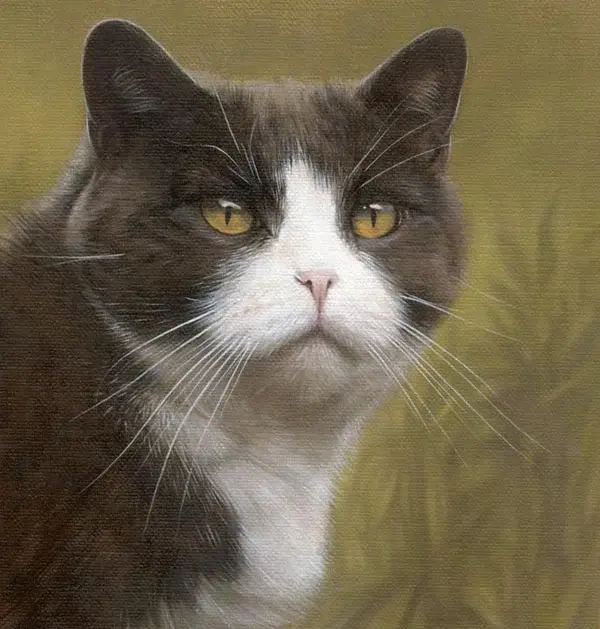
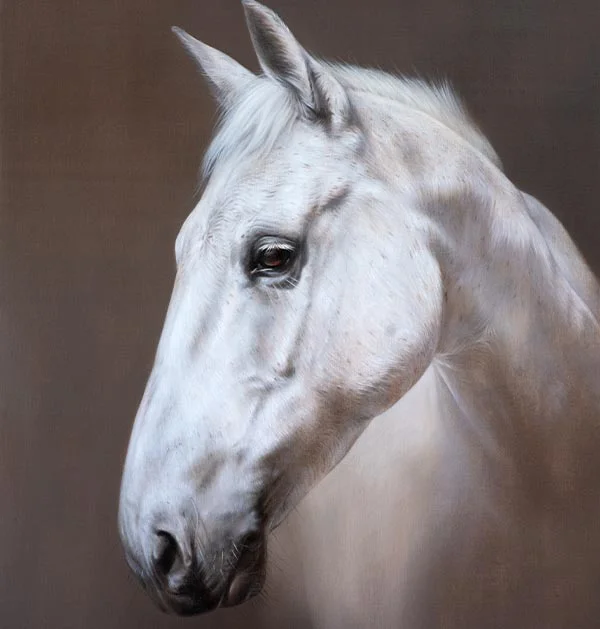
In Depth Guide - Oil vs Pencil Pet Portraits
The most thorough guide to choosing between an oil painting and a pencil drawing written by two artists who create both.
By Melanie Phillips (pencil) and Nicholas Beall (oil) — Professional Pet Portrait Artists since 1996
This is the question we are asked more than almost any other. The right medium depends on things specific to you, your home, your pet, your taste and what you want the portrait to feel like. After 28 years of creating both, plus we have plenty of experiance with all mediums, hopefully we can guide you to the right medium for you.
We are not going to try to persuade you towards one or the other. We love both mediums and are proud of both. What we want to do is give you everything you need to make a decision you will still feel entirely comfortable with when the portrait is hanging on your wall.
What This Guide Covers
- How each medium actually works
- What each medium looks like in reality — colour, tone, texture, surface, presence in a room
- Detail and how fine fur work and individual hairs differ between the two
- Colour. What pencil can and cannot do and what oil brings that pencil cannot
- Backgrounds and landscapes — a significant difference between the mediums
- Framing — glass vs no glass, and why that matters in a real home
- Longevity — how each medium ages and what archival quality actually means
- How your home and décor should influence your choice
- Multiple pets — which medium suits a group portrait
- Specific breeds and coat types — which medium shows them at their best
- Price and timescale — what drives the difference
- A practical decision guide for different situations and budgets
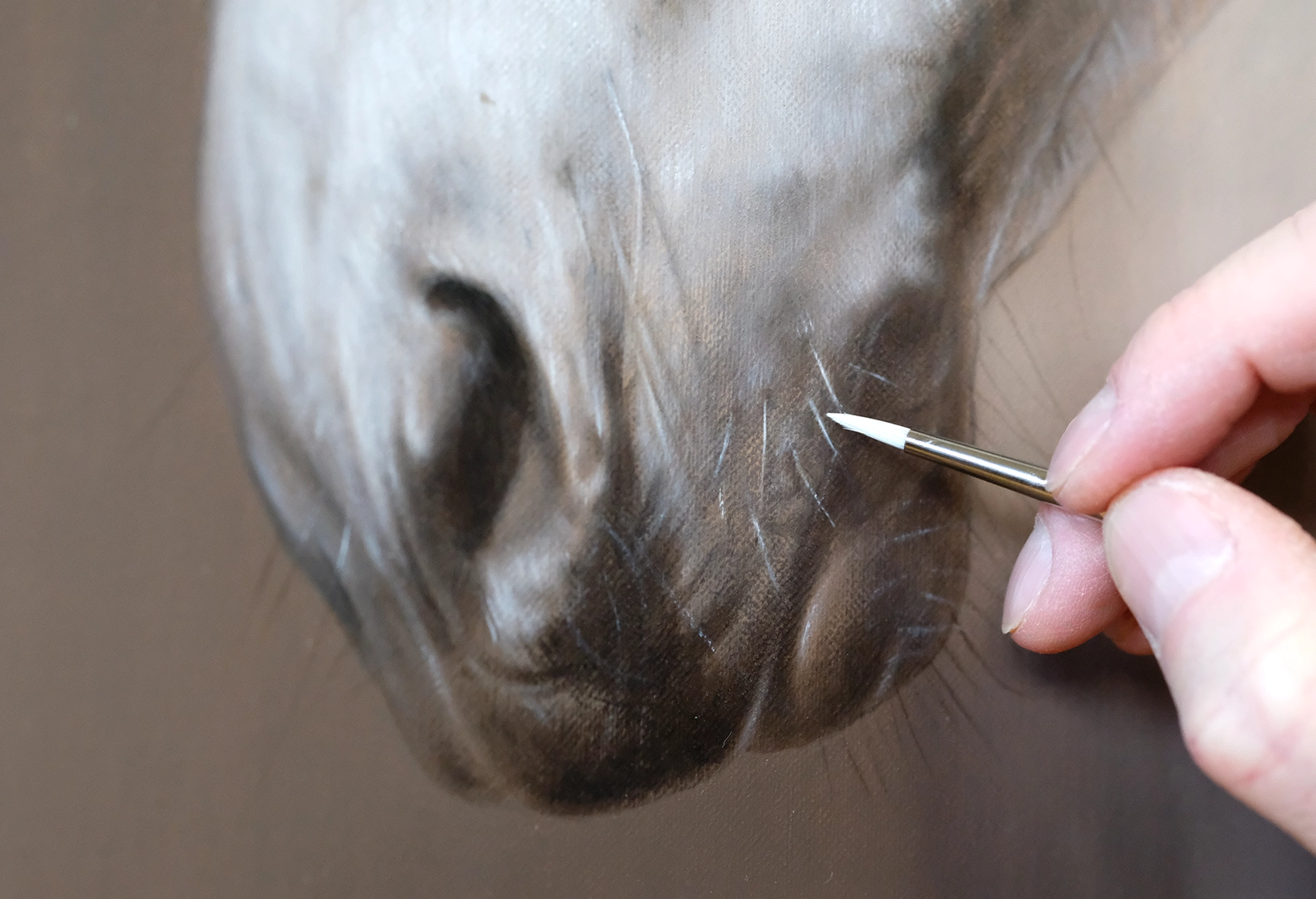 Close detail of a horse oil painting by Nicholas
How Each Medium Actually Works
Before comparing the results, it helps to understand the process. The differences in how each medium is created explain a great deal about why the finished portraits look and feel so different.
Nicholas's oil paintings
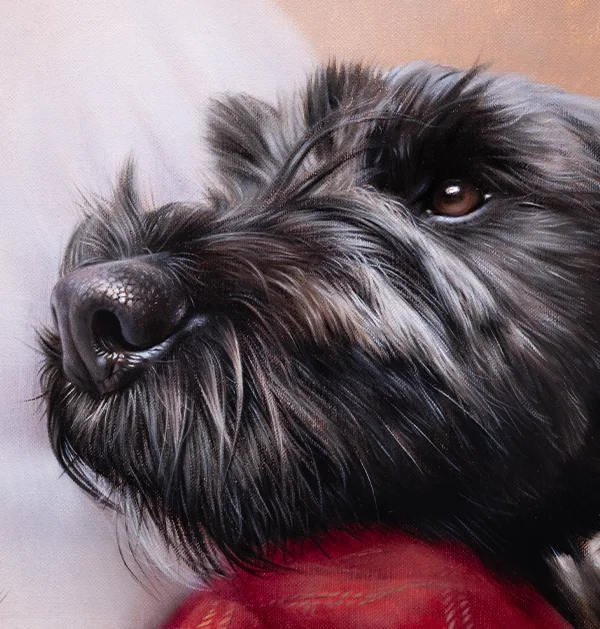
Nicholas paints standing at his easel, working on fine grain linen canvas. He uses Winsor & Newton Artisan water-mixable oils with Da Vinci Nova Series filbert brushes for fine work and Rosemary's Shiraz Short Filberts for broader passages. His background is in seascape and landscape painting in both Cornwall and Wales and that shows in the naturalness of his backgrounds.
An oil painting is built up in layers over time. The first sessions establish structure and tonal values. Subsequent layers add colour, depth and detail. Because oil painting takes time buiidling layers and detail, the process cannot be rushed. This layering is precisely what gives oil paintings their characteristic depth. You are not looking at a flat surface. You are looking through layers of paint, each one modifying what lies beneath it.
Melanie's pencil drawings
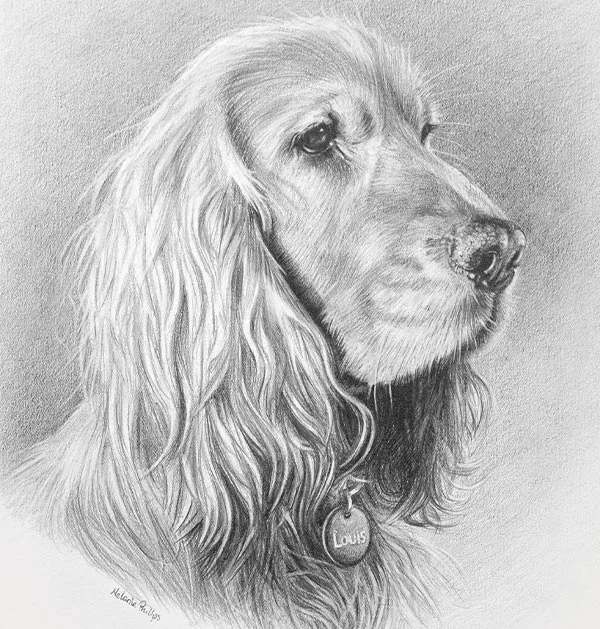
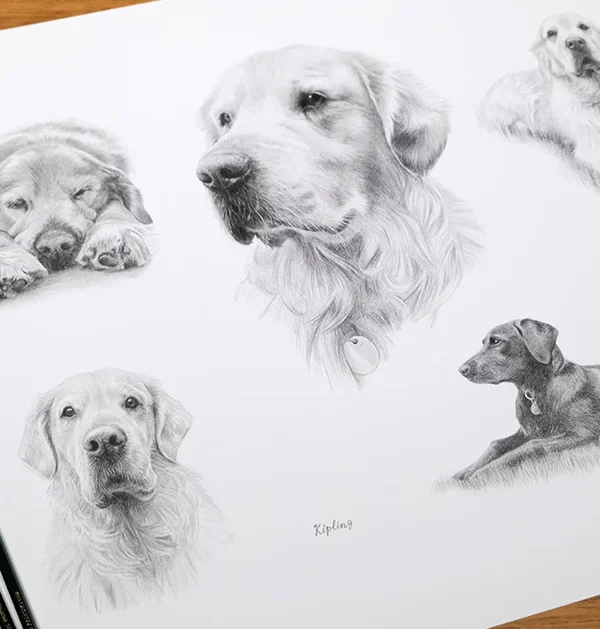
I (Melanie) works at my drawing desk using graphite pencils on Arches Aquarelle Hotpressed paper, Faber-Castell 9000, Staedtler Mars Lumograph, Derwent Graphic, Tombow Mono 100 and Koh-I-Noor, across a range of grades. The drawing is built through many layers of marks and the putty eraser is as important as the pencil. I uses it to lift graphite and create highlights, working both by addition and subtraction.
The texture of the paper is essential. Its slight grain holds the graphite and creates the delicate variation of tone that makes fur look real rather than drawn. Pencil is the most intimate of mediums — there is no colour to hide behind, no paint to blend over a mark that went slightly wrong. Every line and tone has to be placed with precision. If you would like to read more about our art materials have a look at our in depth material guide.
Both mediums require many hours of concentrated work. Neither is quick and the time, along with our skills, are what produce the result.
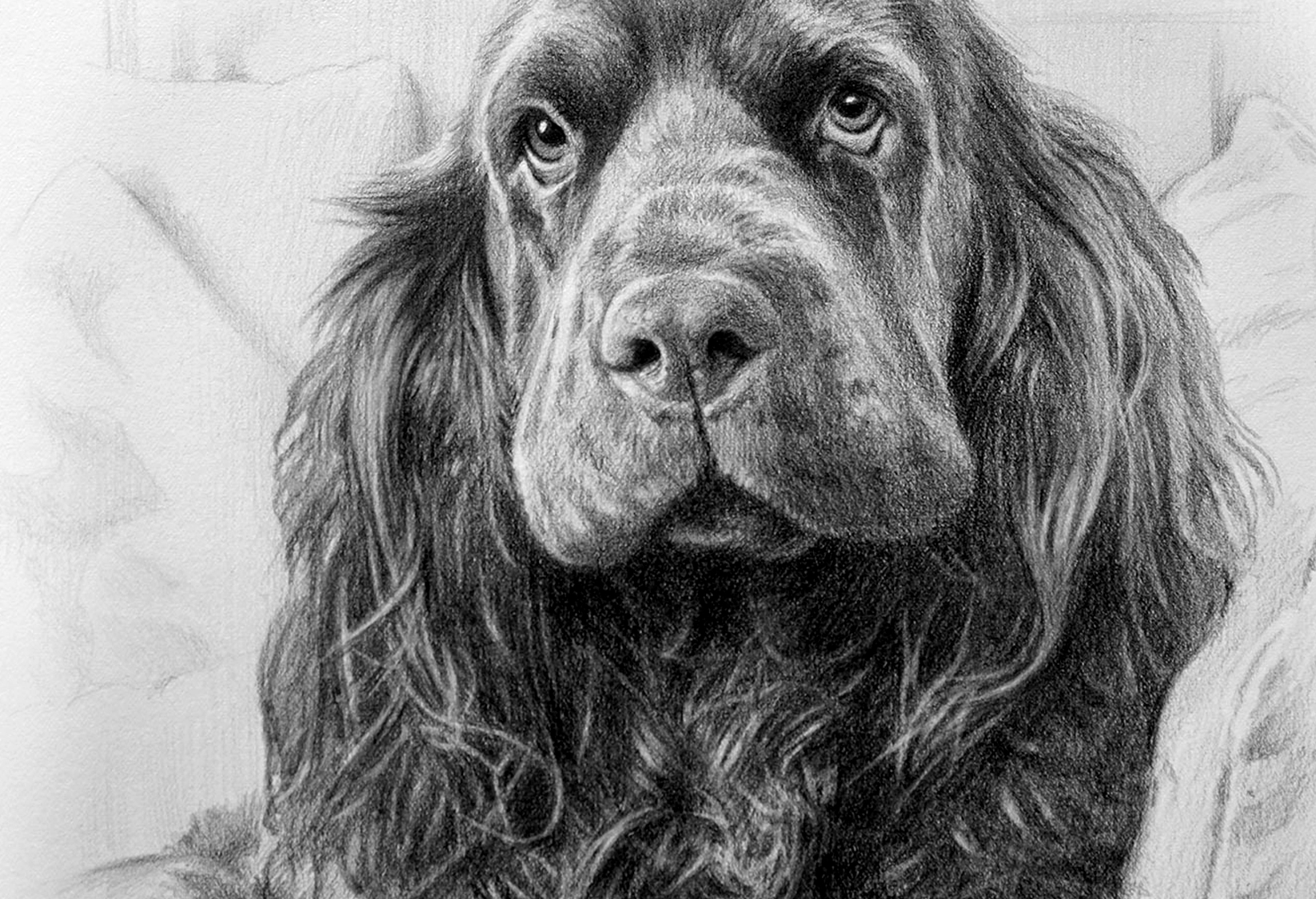 Close detail of a pencil drawing by Melanie
What Each Medium Looks Like in Reality
Photographs on a website can only take you so far. The way a portrait feels in a room, its presence, its surface, the way it changes in different light — is almost impossible to convey on a screen. This is our best attempt at describing what each medium actually looks and feels like when you are standing in front of it.
An oil painting in a room
An oil portrait has physical presence. It occupies a room. The linen canvas has a texture that catches the light differently depending on where you stand and the paint layers above add further complexity. As the light in the room changes through the day — morning light, afternoon sun, evening lamp — the portrait shifts with it. Details that were in shadow appear, highlights become more luminous. An oil painting is not a static object. It has a life to it that is difficult to describe but immediately apparent when you see it.
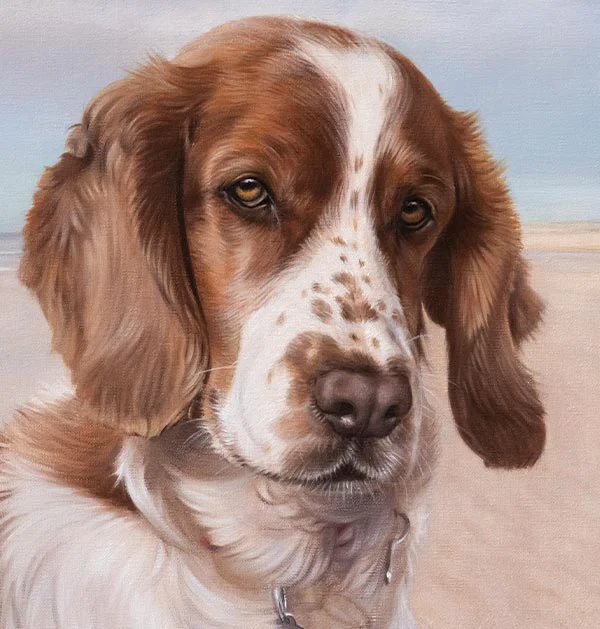
Because oil portraits are displayed without glass, you are always looking directly at the paint. No reflective surface between you and the work. On a bright day there are no glare issues. On a dim evening the colours still read clearly. And in terms of colour, a well-executed oil portrait can capture the exact shade of a coat with remarkable accuracy. The particular gold of a Labrador in autumn light, the blue-grey of a Weimaraner, the warm chestnut of a horse against a green field.
A pencil drawing in a room
A pencil portrait is quieter, where an oil painting announces itself, a pencil drawing invites you closer. The more time you spend with a pencil portrait, the more you see in it.
The paper has a warm cream tone that the graphite sits within rather than on top of. Drawings are framed under glass, which adds a formality and elegance that suits the medium. And because it is black and white, a pencil portrait does not bring its own colour into a room. This is a genuine practical advantage, it will sit comfortably alongside almost any colour scheme, furniture style or other artwork.
Detail — Fur, Whiskers and Fine Lines
Which medium captures fine fur and individual hairs more accurately? The honest answer is that they do it differently.
Pencil as a drawing medium, is built from marks. Every hair in the drawings is a deliberate mark made with a pencil point. The finest grades allow me to work with precision. Individual whiskers, the fine hairs around the muzzle, the texture of an eyebrow. If you look closely, you can see each deliberate stroke.
Oil achieves its fur detail differently. Nicholas paints detailed hair where needed for the focal areas and then softened the chest or background to allow the focis on the face and imporant areas. An oil portrait of a long haired Spaniel will show the flow and movement of the coat in a way no pencil drawing can quite match, because oil allows for that painterly suggestion of movement.
Where each medium excels for fur and coat
- Short, smooth coats (Whippet, Boxer, Dachshund) — both work equally well, oil adds coat colour and warmth
- Long, flowing coats (Spaniel, Afghan, Old English Sheepdog) — oil captures movement beautifully; pencil shows individual strand detail
- Wiry or textured coats (Schnauzer, Wire Fox Terrier, Airedale) — pencil shows the texture explicitly; oil conveys the colour variation within it
- Fine, curly coats (Poodle, Cockapoo, Bichon) — both work well; pencil tends to show the curl structure clearly
- Cat fur — pencil excels for tabby markings and fine facial fur; oil is magnificent for tortoiseshell and pointed coats
- Horse coats — oil is particularly beautiful for capturing the sheen and musculature in different light
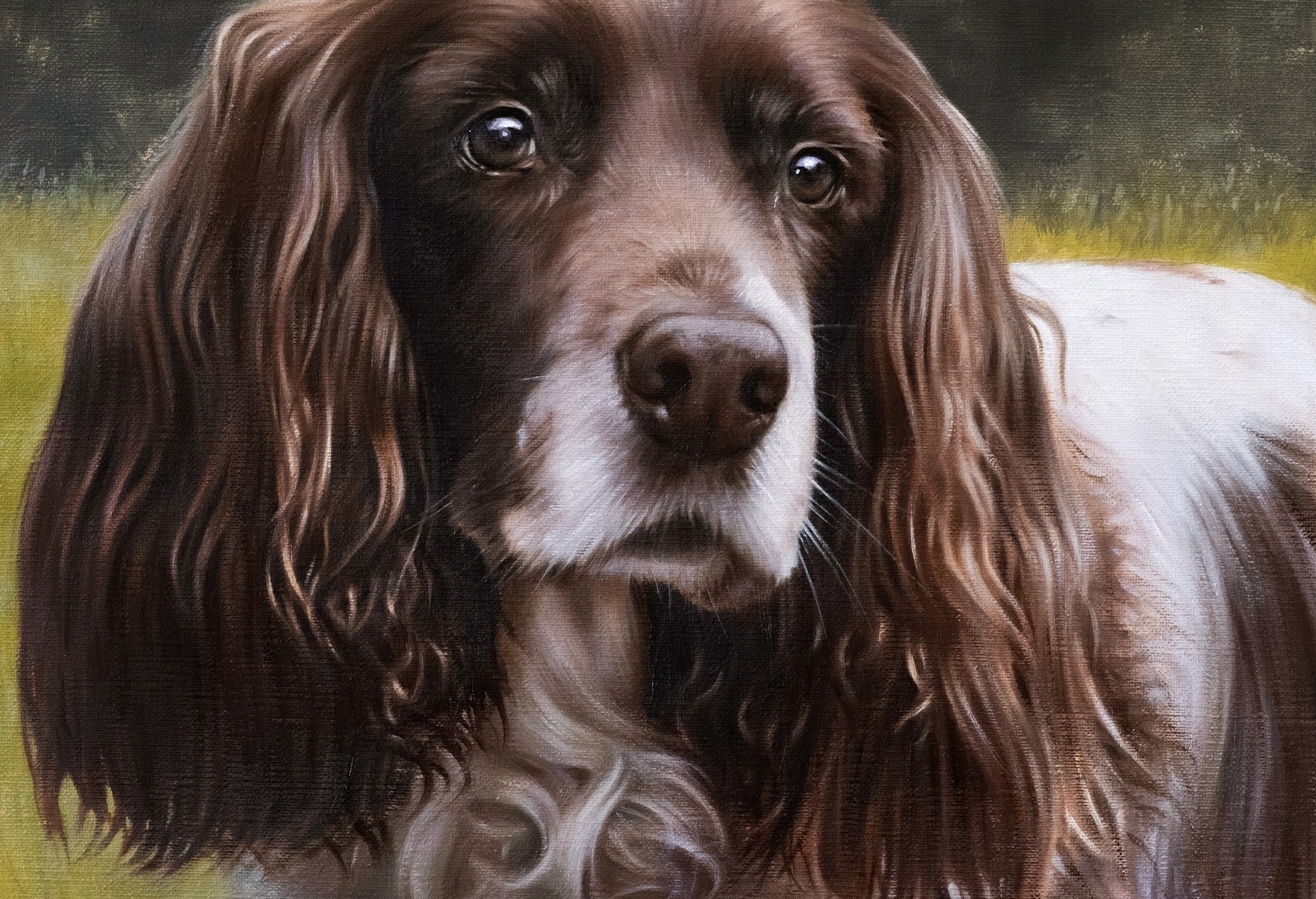 The depth and warmth of oil colour — something graphite simply cannot replicate
Colour — The Biggest Difference Between the Two
This is the most fundamental distinction. Oil paint is a colour medium. Our pencil portraits are monochrome. If colour is important to you — the particular gold of your dog's coat, the green-grey of dappled flanks, the striking orange and white of your cat, then oil is the natural choice. Pencil cannot give you that.
What pencil gives you instead is tonal accuracy. The relative lightness and darkness of everything in the portrait, rendered with extraordinary precision. A really good graphite drawing shows the structure and detail of an animal in a way that is, in its own right, a completely different kind of beauty. The absence of colour focuses the eye entirely on form, expression and character. Many of our clients find pencil portraits more emotionally affecting than oil precisely because of this focus.
If you are genuinely uncertain, here is a practical test. Find one of your favourite photos of your pet and convert it to black and white on your phone. Look at it for a moment. Does it still capture what you love about them? The expression, the character etc If yes, pencil may be exactly right. If something feels missing, if you want the coat colour restored, then oil is almost certainly the better choice.
Colour is not just about how a portrait looks. It is about what you want to keep. If your pet's colouring is one of the things you love most about them, oil preserves that in a way nothing else does.
Backgrounds and Landscapes
This is an area where oil has a clear advantage worth discussing honestly, because it opens up compositional possibilities pencil cannot match.
Nicholas grew up in Cornwall and has painted landscapes throughout his career. His oil portraits regularly feature landscape backgrounds — a horse in a field, a dog on a beach, a pet in a garden. He works from the pet photographs and his knowledge of landscape painting to create a scene that places the animal in a believable, beautiful environment. The result is a portrait that feels complete, not just a study of an animal, but a portrait of an animal in their world.
My pencil drawings can include tonal backgrounds, a softly shaded ground that gives depth and context but cannot include a detailed landscape in the way an oil painting can. The nature of graphite means complex background detail can compete with the subject. Most of Melanie's portraits use a simple tonal background or a very soft suggestion of setting.
If the background matters to you, if you want your horse in a recognisable landscape, or your dog in a specific setting, then oil is almost certainly right. If you want the focus entirely on the animal, both mediums work equally well.
Background possibilities in each medium
- Oil — landscape background — fields, coastline, gardens, woodland; Nicholas can incorporate specific settings
- Oil — simple tonal background — warm graduated colour that frames the subject without competing
- Oil — suggested setting — loose painterly impression of environment rather than detailed scene
- Pencil — plain white paper — clean and elegant, lets the drawing speak entirely for itself
- Pencil — soft tonal background — gently shaded ground that gives depth without specific detail
- Pencil — Life Story composition — multiple images combined into one design, creating its own visual context
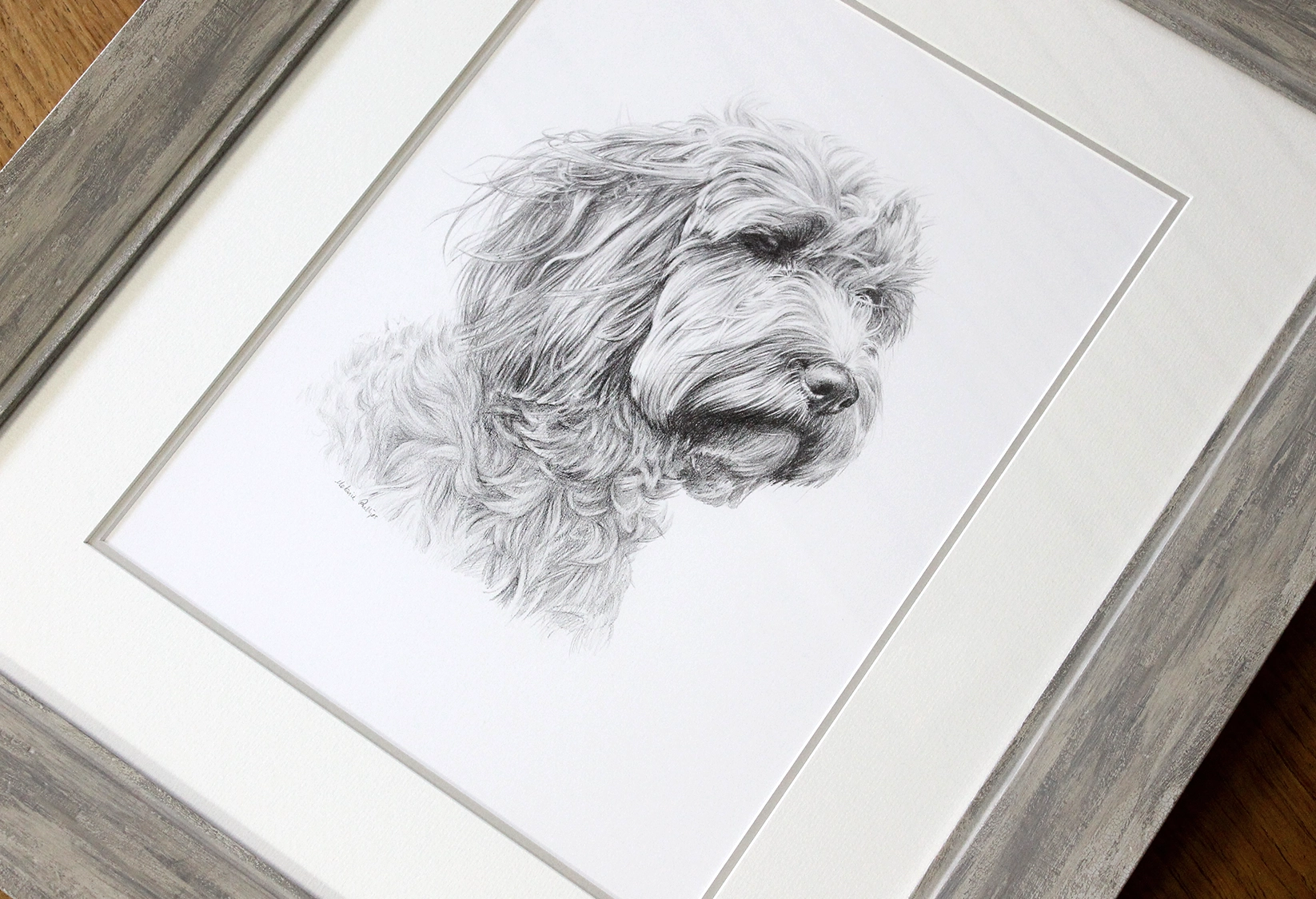 A pencil portrait framed under glass, the mount keeps the glass from touching the surface
Framing — Glass or No Glass
This practical distinction has a real effect on how the portrait lives in your home, and it is one clients sometimes overlook until thinking about where to hang the finished work.
Pencil drawings — framed under glass
Graphite is a delicate medium. The marks on paper are not fixed. If the drawing were touched, or exposed to humidity without protection, the graphite would be vulnerable. Framing under glass is essential. The glass must always be separated from the drawing by a mount, which creates a gap allowing the paper to breathe and prevents any moisture from reaching the artwork.
Glass framing gives pencil portraits a particular look classic, a little precious in the best sense. The frame and mount become part of the overall presentation. Practically, glass means the portrait can reflect light in certain conditions. Modern non-reflective glass and acrylic glazing help significantly. It is worth considering where the portrait will hang and what the light sources are before choosing your glazing.
Oil paintings — displayed without glass
Oil paintings do not need glass. You look directly at the painted surface with nothing between you and the work. The texture of the brushwork and canvas are fully visible. The practical advantages are real, no reflections, no glare, no risk of condensation. Oil portraits in open frames tend to feel like what they are, traditional fine art. They are also forgiving about where they hang. North facing rooms, hallways, areas with multiple light sources — an oil portrait works in all of these.
We no longer offer framing for either medium. Our brilliant framers retired and we made the decision not to replace them. But we are always happy to advise and if your framer has any questions they are welcome to contact us directly.
Longevity — How Each Medium Ages
Both oil and pencil, created with professional-grade materials and properly cared for, are archival. They are built to last for generations. But they age in slightly different ways.
Oil paintings
Traditional oil paintings are among the most durable artworks ever created. The oldest surviving oil paintings are over five hundred years old and still vivid. A well-made oil portrait, properly varnished and kept away from direct sunlight and extreme humidity, will outlast everything else in your home. Nicholas uses professional-grade Winsor & Newton Artisan oils on high quality linen canvas, archival materials made to last.
Pencil drawings
Graphite is one of the most stable artistic media available. It does not fade, does not discolour significantly and does not react chemically with paper in the way some other media can. The main vulnerabilities of a pencil drawing are physical, smudging if touched, entirely preventable with proper glass framing and acid-free mounting.
Both mediums, made with our materials and properly cared for, are built to last for generations. This is not a wall decoration — it is an artwork that will still be in your family long after you are gone.
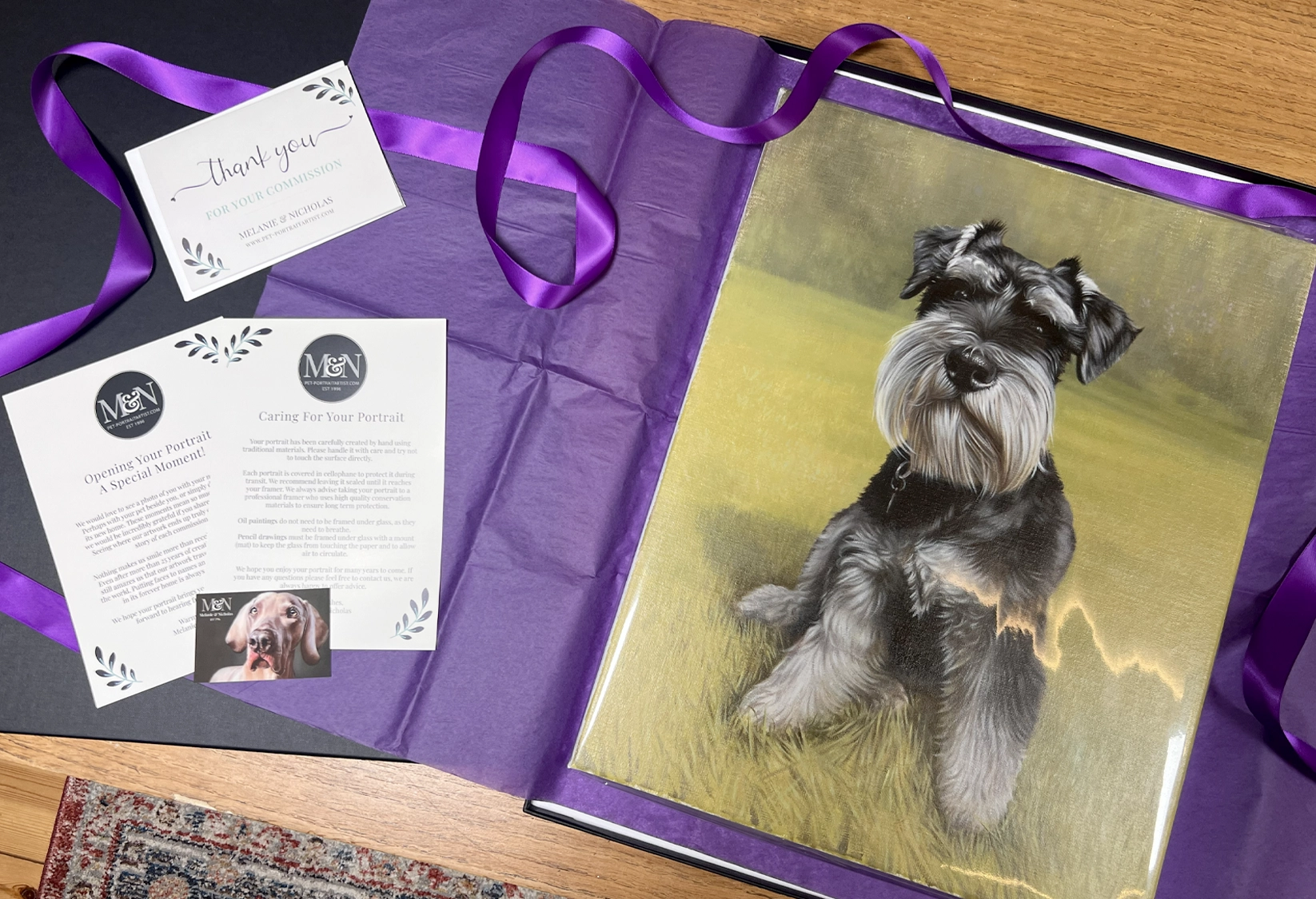 Meg a Miniature Schnauzer oil portrait by Nicholas before dispatch
Your Home — The Most Important Factor
Of all the considerations in choosing between oil and pencil, where the portrait will hang is the most practical and the most important. A portrait perfectly matched to the right wall in the right room is always more successful than one that looks slightly out of place, however beautiful it might be in isolation.
An oil painting is a statement. It tends to work best as the main focus of a wall rather than one of several pieces competing for attention. It suits rooms with space and character — a living room, a study, a hallway where it will be seen every day. A pencil portrait is more adaptable. Because it is monochrome, it sits quietly alongside almost anything. It can be one of several pieces on a picture wall. It can go in a bedroom, a study, a landing.
Both mediums suit traditional homes beautifully. In a more contemporary home, both can work equally well, but the frame choice becomes more important. A simple clean frame suits a contemporary oil portrait; a pencil portrait in a clean white frame with a narrow mount feels equally at home in a modern interior.
Quick guide by space and situation
- Large living room, main focal point — oil painting is the natural choice
- Study or library — both work; pencil has a particular affinity with book-lined rooms
- Bedroom — pencil tends to feel more intimate and suits a bedroom well
- Hallway — both work; pencil handles varying light conditions more easily
- Picture wall with other pieces — pencil is more versatile alongside other artworks
- Cottage or country house — both are at home; oil particularly suits spaces with character
- Contemporary apartment — both can look stunning; oil makes a bolder statement
Multiple Pets — Which Medium Suits a Group Portrait?
A portrait of two or more animals in one composition requires more space and the choice of medium can affect how well a group portrait works.
For two pets in pencil, a 16x12 inch drawing tends to work well for a double head study. Three pets in pencil works at 18x14 or 20x16. The monochrome nature of pencil actually helps with group compositions, it unifies different coat colours and patterns under the same tonal framework, which can make a busy composition feel more cohesive.
For two pets in oil, an 18x14 inch canvas is our usual starting point, 16 x 12 at a push depending on the pets in question and the compostion. Oil portraits need a little more room to breathe and the colour and texture of each coat needs space without the animals feeling cramped. For three or more pets in oil a 20x16 or larger gives Nicholas the room to do each animal justice. We do not charge extra for additional pets — they simply need to fit comfortably on the chosen size.
Price and Timescale
This is often what makes the final decision.
Pencil portraits — from £375
My pencil portraits start at £375 for an 8x6 inch drawing and go up to £1,250 for a 20x16 inch. Life Story portrait montages start at £1,200. A £200 deposit secures your place.
Oil paintings — from £1,600
Our oil paintings start at £1,600 for a 12x10 inch canvas and go up to £5,000 for a 40x30 inch. A £500 deposit secures your commission. An oil painting is an investment and it should be thought of as one. Many of our clients who have commissioned oil paintings describe them as the most significant piece of artwork they own.
Timescale
Both Nicholas and myself are expremely busy with our artwork and we have waiting lists. If you have a specific deadline, tell us when you get in touch. Full pricing is on our prices and commission information page.
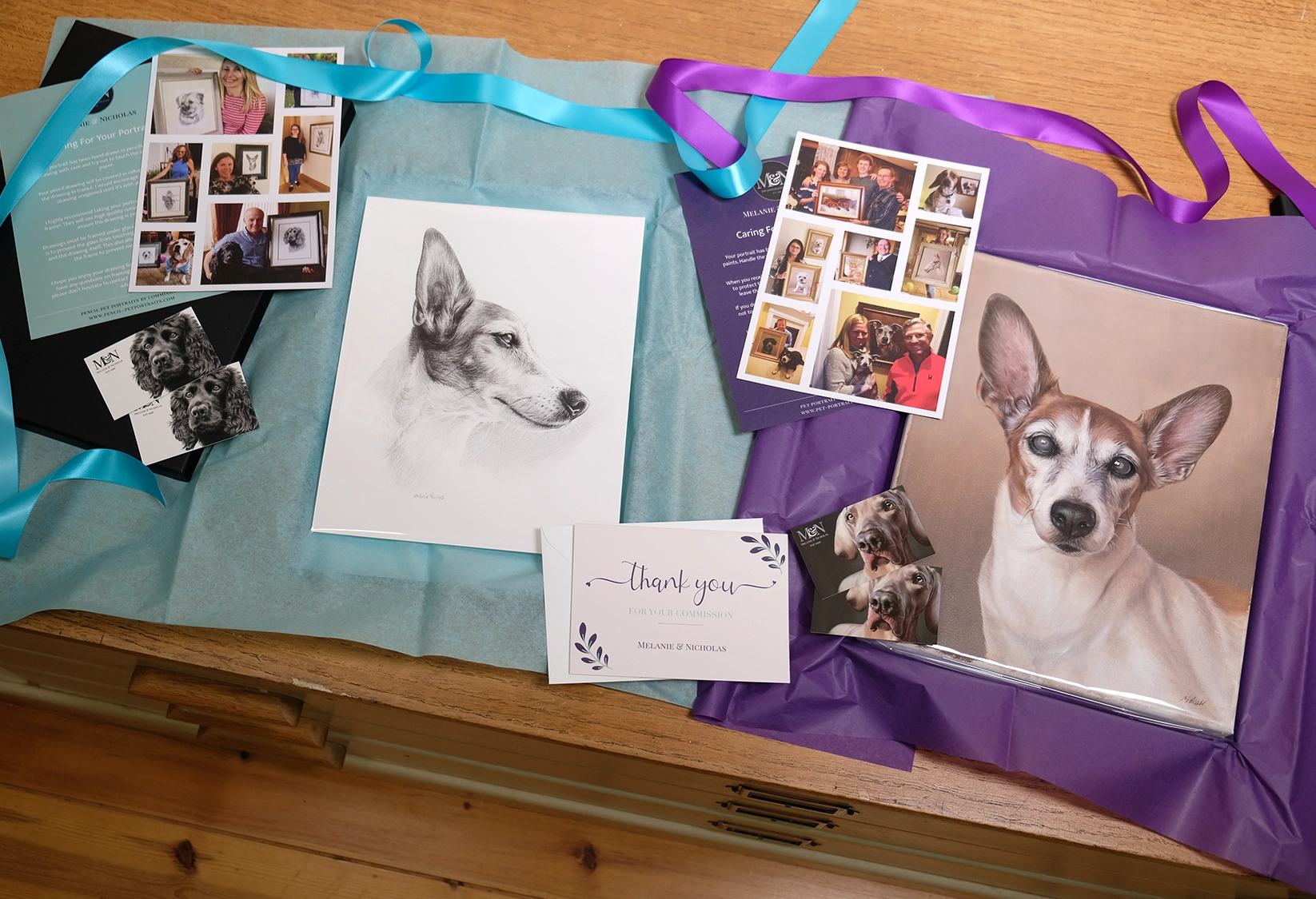 The two mediums side by side commissioned of Dodge for clients in Singapore
The Decision — Honest Advice for Specific Situations
Rather than a simple checklist, here is our honest advice for a range of real situations. These are the conversations we actually have with clients who cannot quite decide.
"I want to capture my dog's colour — the gold in her coat in the sunshine."
Oil. Without question. Pencil cannot give you that gold. Nicholas can paint it in a way that captures the specific warmth of a coat in a particular light. This is one of the things oil does better than any other medium.
"I love classic black and white art and want something elegant and timeless."
Pencil. This is exactly what Melanie's drawings are. The absence of colour is not a limitation here — it is the point. A beautifully drawn graphite portrait has a timeless quality that colour sometimes cannot match.
"My budget is £500 and I want the best portrait possible."
Pencil. At £500 you can have a beautiful 9x7 or 10x8 inch pencil portrait — a genuinely impressive piece of original artwork. Oil paintings start at £1,600 and that is what they cost to make properly. We would never advise cutting corners on an oil painting budget.
"I want something for a large wall — a real statement piece."
Both can work at large sizes, but if colour matters, a large Nicholas Beall oil painting is extraordinary on a wall. If colour is less important, a 20x16 inch pencil drawing is equally imposing and often quieter and more versatile alongside the other things in the room.
"My horse has a beautiful dappled grey coat and I want that captured properly."
Oil. The colour variation within a grey horse's coat — the blue-grey tones, the dappling, the way it shifts in light — is something oil handles magnificently. And Nicholas can place the horse in a setting that adds to the portrait naturally.
"It's a memorial — my cat who passed away. I want something meaningful."
Both work beautifully for memorial portraits. If your cat's colouring was striking and part of what you loved about them, oil preserves that. If you want something classic and quiet that you can look at every day without it overwhelming the space, pencil is often the choice our memorial clients make. There is no wrong answer — do what feels right to you.
"I genuinely cannot decide."
Send us your photos and ask. We will look at the pet, listen to what you tell us about your home and what you want the portrait to feel like, and give you our honest recommendation. We have done this for 28 years. It does not take long and there is no obligation. Just get in touch.
Oil vs Pencil — Questions Answered
Neither is better — they are genuinely different. A pencil portrait is classic, elegant and timeless. It works in any home and captures fine detail and expression beautifully in black and white. An oil painting is rich, colourful and bold — a statement piece that brings a pet's coat colour and character to life in a way pencil cannot. The right choice depends on your taste, your home, and what you want the portrait to feel like. If you genuinely cannot decide, send us your photos and we will advise honestly. There is no obligation.
Pencil is the more explicit in terms of fine line work, individual hairs, delicate whiskers, the precise structure of an eye. But oil achieves its own kind of detail through colour, tone and the way paint layers interact. At normal viewing distance, a well-executed oil portrait shows extraordinary detail — achieved differently. For fine fur detail as visible marks, pencil tends to show it most clearly. For colour accuracy and depth, oil delivers what pencil simply cannot.
No — our pencil portraits are graphite on paper, which means they are black and white. Pencil captures tonal values with great precision, but it cannot reproduce colour. If your pet's colouring is one of the things you most want to preserve, oil is the medium that does that. If you love the idea of a classic black and white portrait and colour is less important to you, pencil is beautiful in its own right.
No. Oil paintings on canvas are displayed in an open frame with no glass — you look directly at the painted surface, seeing the texture of the canvas and the brushwork. This means no glare, no reflections, and no risk of condensation. Pencil drawings must be framed under glass with a mount to protect the graphite surface. We are happy to advise on framing for both mediums — and if your framer has questions, they are welcome to contact us directly.
If you have a specific deadline, or wish to give the portrait to someone as a gift, please let us know as soon as possible. We are working a number of months in advance all year round, we have a waiting list, so let us know your requirements.
Pencil is more affordable. Our pencil portraits start at £375 for an 8x6 inch drawing; oil paintings start at £1,600 for a 12x10 inch canvas.
Horses suit both mediums, but oil has a particular advantage. The colour variation in a horse's coat, dappling, the way a grey shifts in light, the warmth of a chestnut — is something oil captures magnificently. Nicholas's landscape background also means he can place horses in a setting very naturally. That said, Melanie has created many beautiful horse pencil drawings that capture expression and the fine detail of the head with great precision. If colour matters, oil. If you prefer classic and monochrome, pencil works beautifully too.
Both handle dark-coated and black animals well when the reference photograph is good. In pencil, the contrast between dark fur and the warm cream of the paper creates a beautiful tonal effect. In oil, Nicholas can capture the subtle colour variation within a dark coat — the blue-black sheen of a Labrador, the warm highlights in a black Cocker's fur. Good natural light in the photo is essential for both mediums. See our photography guide for advice on photographing dark-coated animals.
Both work well. For pencil, a 16x12 inch drawing suits a double head study comfortably. For oil, an 18x14 inch canvas is our recommended starting point for two subjects. The monochrome nature of pencil can be an advantage in a group portrait, unifying different coat colours within the same tonal framework. We create a composition mock-up before starting any group portrait so you can see the arrangement before we commit to it. We do not charge extra for additional pets.
Yes — we have extensive galleries of both. You can browse Melanie's pencil portrait gallery and Nicholas's oil painting gallery. We can also create a mock-up using your photos showing how the portrait might look in both mediums, which many clients find very helpful. Just send us your photos and ask — there is no obligation and no charge for this.